

Among these manuscripts are four that have been associated with Jacques Rapondi, a member of the Lucchese family of merchants and bankers active in Paris. Together with his brothers Dino and Filippo, Jacques maintained close ties to Philippe the Bold, Duke of Burgundy, and the Burgundian accounts document his role in supplying the duke with luxury manuscripts. On the basis of this evidence, Brigitte Buettner and Patrick de Winter have suggested that Jacques acted as the libraire responsible for overseeing the production of these books.

Although Jacques Rapondi was undoubtedly the driving force behind these commissions, it seems unlikely that he personally fulfilled the day-to-day responsibilities of a libraire. As a merchant and financier, he was more likely to have relied upon an experienced member of the Parisian book trade to coordinate the numerous specialists involved in each project. The strongest candidate for this role is Cleres femmes Scribe A, whose participation, as the accompanying chart demonstrates, is remarkably consistent throughout this group of manuscripts.
We have seen that Scribe A served as the principal copyist in all three Cleres femmes manuscripts. The same pattern recurs in most of the manuscripts examined here, where Scribe A is regularly responsible for copying the opening portions of the text. Moreover, evidence from BnF fr. 598 suggests that this individual’s responsibilities extended beyond copying alone. In that manuscript, Scribe A added rubrics to sections copied by Scribe B after the secondary decoration had already been completed, as demonstrated by the rubrics overlapping both the decorated initials and the gilded miniature frame. Since secondary decoration normally began only after the scribes had finished copying the text, this sequence indicates that Scribe A continued to supervise the manuscript during later stages of production.


Oudin de Carvanay was the scribe responsible for both pages. The characteristic letter forms like the "g" with the long fluid tail , the pot-bellied "s," the "y" with the characteristic accent, and the line filler are found on both pages. These dedicatory texts are preceded by lists of titles which form self-contained textual units, allowing them to be one of the last things done in the respective manuscripts. The scribe of the titles of KBR 9094 is not Oudin but a scribe who appears later in the manuscript. The dedicatory texts of both KBR 9509 and KBR 9094 are integral to the regular gathering structure which contain the actual opening of the texts of the respective manuscripts. In KBR 9094, the text begins on folio 12r with a four-part frontispiece with miniatures by an artist Michael Camille has identified as Perrin Remiet who was the principal miniaturist of BnF fr. 823 and will contribute to at least one more manuscript in the Cleres femmes group.3 Since the dedication and opening of the text are the major openings in the manuscript. it is evident that Oudin was the primary scribe as we have already seen in the other Cleres femmes manuscripts.

 While likely the primary scribe, Oudin's contributions are relatively limited. His first stint only extends to folio 17r, the first folio of a new gathering. He is succeeded by a scribe who we have not seen before. This scribe's "g", "s", "y", and line-filler are clearly distinct from Oudin. The "y" with its sharp descender going down to the left and distinct accent is almost a signature for this scribe and enables the identification of their work in other manuscripts including a Livy manuscript in the National Gallery of Victoria in Melbourne (MS. Felton 411/4).
  On folio 510v of the Melbourne manuscript appears the signature of the scribe, Gillequin Gressier.4Unfortunately, this is the only known record of Gillequin. This scribe will return at the end of KBR 9094 with a new scribal unit beginning on folio 325r and ending on folio 352.
Oudin de Carvanay picks up on folio 34 at the beginning of a new gathering. Since there is no break in text, this portion continues the earlier unit. While the general practice is to allot scribes a group of gatherings so that they can work concurrently and independently, this stint presents a more complicated division of labor. This portion represents the first appearance in KBR 9094 of the Cleres femmes Scribe C. While this scribe will be responsible for a large stint later in the manuscript extending from folios 152-324, the division of labor in this earlier portion shows Oudin and Scribe C collaborating even on individual gatherings. An analysis of a single gathering comprising folios 72-79 will demonstrate the complexity of this division of labor. Oudin begins the gathering on folio 72 (no. 1) and is responsible through the left column of folio 73v (no. 2) while Scribe C is responsible for the right column and continues to folio 74v (no. 3). Oudin returns on folio 75r (no. 4), but then abruptly stops at the top of the right column of folio 75v (no. 5) with Scribe C returning and completing the gathering (no. 6).


The Légende du Saint-Voult is an illustrated narrative about the creation, translation, and miracles associated with devotional crucifix from Lucca. Believed to have been carved by Nicodemus, a secret disciple of Christ, the statue was miraculously transported to Lucca. The Saint Voult was especially venerated by merchants from Lucca in various commercial centers of Europe. The Lucchese merchants in Paris established a special chapel in the Church of the Holy Sepulcher in honor of the crucifix.

The Légende is a French translation of an original text believed to have been written by Leobinus in the eighth century with later additions. While the author of the French translation is not certain, Hilary Maddocks has made a strong case that the Carmelite Jean Golein was responsible.8The Vatican manuscript opens with a miniature attributable to the Coronation Master showing two figures kneeling before the statue. The two figures have been convincingly identified as Dino and Jacques Rapondi, for whom this image had special meaning.
Examination of the scribal work reveals the now familiar work of Oudin de Carvanay. Again the distinctive treatment letters "g", "s," and "y" supports this attribution. The appearance of this scribe's work further confirms the conclusion that the Vatican manuscript was commissioned by Jacques Rapondi.


The decorator of the Saint-Voult manuscript is not one of the Cleres femmes decorators but one who can perhaps be identified as the decorator of BnF fr. 823. The similarity of the tendrils of the penned rinceaux and the appearance of a trilobed gold ornament suggest that both pages were done by the same decorator.
The remaining miniatures have been the basis of the identification of a distinct miniaturist, the Master of Saint-Voult. The work of this artisan will be found in at least one other project with Oudin de Carvanay as scribe.

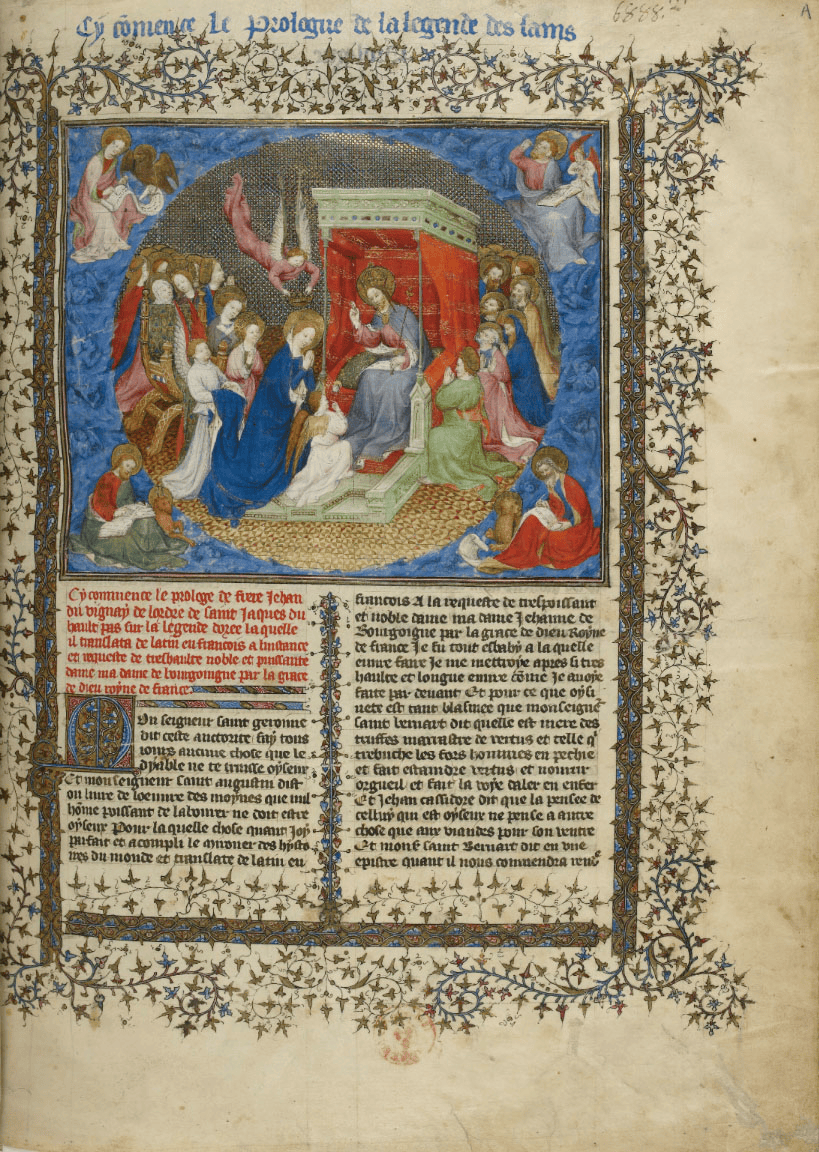
In 1401 or 1402, Jean Golein completed a translation of the so-called Festes nouvelles that supplemented the original French translation by Jean de Vignay of Voragine's Legenda aurea. The focus of Golein's supplement is on saints and feasts that have a special appeal to a French audience. It is significant that the text ends with an extensive account of the Volto Santo. Hilary Maddocks has made the plausible argument that Jacques Rapondi was responsible for the inclusion of this text with special appeal to a Lucchese audience. She has even proposed that Jacques was responsible for commissioning Golein's translation. Examination of an early copy of this expanded version of the Légende dorée in the Bibiothèque nationale, BnF fr. 242 gives support to this conclusion. This manuscript opens with the eponymous miniature for the Coronation Master. This marks the fourth appearance of this artist's work in manuscripts associated with Jacques Rapondi. This along with the similarities of the miniatures dedicated to the Saint-Voult in BnF fr. 242 to those in the Vatican manuscript have lead Maddocks to suggest that Rapondi had supplied the Duke of Burgundy with this copy of the Légende dorée.9 This suggestion receives further confirmation when the script and decoration are considered.

Oudin de Carvanay was not responsible for copying the text of the manuscript. This can be attributed to a scribe we have not seen before but can be shown to have collaborated with the Cleres femmes C Scribe in two copies of the Bible historiale. This scribe is here identified as the fr. 242 Scribe. Instead, Oudin appears responsible for the running-titles in BnF fr. 242. In the title for the opening miniature are seen Oudin's characteristic "g," "s," and "y." Responsibility for the running-titles suggests a supervisory role characteristic of a libraire. This involvement of Oudin de Carvanay as the likely libraire of BnF fr. 242 tightens the link between the augmented version of the Légende dorée and the Vatican Légende du Saint Voult.
The decorator of the frontispiece of BnF fr, 242 is identifiable as the Cleres femmes E Decorator who we have already seen contributing to four other manuscripts connected to Oudin and Jacques Rapondi.


The scribe who contributed to KBR 9094 who was identified as Gillequin Gressier also worked on the Soissons Bible historiale. The identification of Gillequin's work is substantiated by examining a detail of folio 206v of Soissons ms. 210.  Here we find the characteristic letter forms including the "g," "h," "s," and especially "y" of Gillequin Gressier found in the Melbourne Livy.


Identifying the scribes and decorators of Reg. lat. 35 links this project to the group of manuscripts connected to Jacques Rapondi and the patronage of Philippe le hardi. Reg. lat 25 differs from both BnF fr. 167 and BnF fr. 166 by the text opening with a half-page miniature Genesis scene with the marriage of Adam and Eve on folio 3r. The scribe of this page is identifiable as Oudin de Carvanay. As we have seen in other manuscripts this scribe can be identified as the principal scribe, being responsible for the opening portion of the manuscript through folio 31. Beginning on folio 32, the Cleres femmes Scribe C takes over.

Pages with miniatures through folio 101v present an intriguing exception. Since Reg. lat. 25 is a faithful copy of the text of BnF fr. 167, page by page, column by column, each column of text is effectively a separate scribal unit. This means that the two columns of text on a page could have been done at separate times and not necessarily in consecutive order. With few exceptions in Scribe C's stint from folio 32 through folio 101r, Oudin was responsible for the columns of text containing miniatures and the openings of texts, while the other column was the work of Scribe C. In the case of folio 46r illustrated above, Cleres femmes Scribe C was responsible for the left column and the right column was the work of Oudin. This division of labor again shows the priority of Oudin de Carvanay, and like what we saw in KBR 9094, the close working relationship of the two scribes with both working possibly in the same workshop.
As in BnF fr. 167, the beginning of the Book of Psalms is the only major break in the text. In both manuscripts, the openings which begin new gatherings are preceded by singletons with the text ending on the rectos and the versos being left blank. At this point in Reg lat. 25, the Cleres femmes Scribe C takes complete responsibility with the transcription of the text.
The decoration of Reg. lat. 25 can be attributed to the Cleres femmes group. The A Decorator was responsible for a single page, the Genesis frontispiece. This page is given special prominence with an elaborate staff which contains motifs used by the Cleres femmes A Decorator in other manuscripts. The decoration of the remaining text openings have simple bar staffs and can be attributed to the Cleres femmes B Decorator (see for example folio 46r illustrated above).
An intriguing possibility is presented by the following entry in the Burgundian accounts dated May 22, 1407:
A Jaques Rapponde, la somme de LX frans d'or lesquelz du commandement de feu monseigneur le duc cui Dieu pardoint et par ordonnance de maistre Jehan Durant conseillier de mon dit seigneur, ycellui Jacques bailla et delivra pour faire ystores en la Bible en latin et en françoiz que ledit feu mon seigneur faisoit faire, laquelle mon dit seigneur a donnee a mon seigneur de Berry, aux personnes qui s'ensuivent. C'est assavoir a Ymbert Scanier enlumineur, XXIIII frans le premier jours de mars mil CCCC et III. Item, le IIIIe jour dudit mois envisant a Jaques Cont paintre, XX frans. Item, a Hainsselin de Haguenot enlumineur le XVIIe jour de may mil CCCC et quatre, XVI frans. Pour ce, par mandement de mon dit seigneur donné a Confflans lez Paris le XXIIe jour de may mil CCCC et sept, cy rendu avec quittance dudit Jaques et certifficacion dudit maistre Jehan Durant sur la delivrance duit argent LX frans.13
The account entry records a payment to Jaques Rapondi of 60 "frans d'or" by order of Jehan Durant, counselor of the Duke of Burgundy, for miniatures made for a "Bible en latin et en françoiz." The 1407 payment was made by Jean sans Peur to cover the expense incurred by his father who had died in April of 1404. The manuscript, made at the order of Philippe le hardi, was intended to be given to his brother, Jean de Berry. The three artists listed are: Ymbert Scanier, Jacques Cont , and Hainsselin de Haguenot. On the basis of the identity of the illuminators listed, this must be a record for a different manuscript than Reg. lat. 25. "Jaques Cont" listed in the entry is Jacques Coene, a Flemish painter living in Paris who provided Alcherius with a number of recipes for colors included in his treatise. Meiss has speculated that Jacques Coene was the Boucicaut Master. More recently, Albert Châtelet has has identified Jacques Coene as the Coronation Master who we have seen has been a regular contributor to projects associated with Jacques Rapondi.14 Hainsselin de Haguenot or Haincelin de Hagenau has been frequently identified as the Bedford Master.
The other factors recorded in the account entry correspond closely to Reg. lat. 25. The reference to a Bible in Latin and French is consistent with a Bible moralisée. BnF fr. 167, BnF fr. 166, and Reg. Lat. 25 are all bilingual copies of the Bible moralisée. but the price of 60 francs would hardly cover the cost of the over 5,000 miniatures needed to illustrate a Bible moralisée like BnF fr. 167 or 166. Instead with the more limited pictorial cycle of 76 illustrations in Reg. lat. 25, the 60 "frans d'or" would generously cover the cost for the miniatures of another Bible moralisée like Reg. lat. 25. 76 miniatures for 60 francs would cost roughly 16 sous apiece.15


Jean Durant was the physician and advisor of Philippe le hardi. The documents make clear that Durant supervised Pol and Jehan van Lymborch in the creation of Philippe le hardi's copy of the Bible moralisée. BnF fr. 166's page for page transcription of BnF fr. 167 indicate that the latter manuscript or a workshop copy was available for the makers of BnF fr. 166 to copy. The same applies to Reg. lat. 25 also based on BnF fr. 167 or a workshop copy. While many of the miniatures in Reg lat 25 appear to be based on the same written instructions, John Lowden has observed that some of the miniatures in Reg. lat. 25 differ from BnF fr. 167. As an example he points to the respective miniatures introducing the Book of Job.16 In Reg. lat.25, the miniatures use the iconography of the Madonna of Mercy to show the towering figure of Job sheltering his family while in the moralization the Pope shelters members of the church. The corresponding images are a lot less coherent in their messages with the Biblical verse illustrated by the enthroned Job speaking to his children and in the moralization two couples are shown greeting each other. The clarification of the iconography evident in Reg. lat. 25 likely reflects the instructions of a supervisor like Jean Durant.
The payment of 60 francs made to Jacques Rapondi was just for the painting of the miniatures. Presumably there would have been a separate payment to the scribes and decorators. But in any case as we have seen the scribes and decorators responsible for Reg. lat. 25 were regulars in other Rapondi projects.
While the 1407 Burgundian account entry refers to a different manuscript than Reg. lat 25, it is likely that this other manuscript was a twin to Reg. lat. 25 like the three Cleres femmes manuscripts , fr. 12420, fr. 598, and KBR 9509 are related. The Boccaccio manuscripts were the work of distinct miniaturists, but as we have shown the same scribes and decorators worked on both manuscripts. We have seen in the case of the Hayton text, Philippe le hardi had three copies of the same text made to be shared with his brother Jean de Berry and his nephew Louis d'Orléans. The manuscript in the Burgundian account was made for Jean de Berry. We do not know who was the original owner of Reg. lat 25, but it seems plausible that the manuscript was destined for the Duke of Burgundy or another member of his family.


A central aim of this discussion has been to demonstrate that the contributions of individual scribes and decorators can be identified with considerable precision. The success of a scribe or decorator depended on their ability to maintain the unity of the manuscript as a whole, but close examination of a scribe’s treatment of letterforms, details such as catchword decoration, and characteristic scribal practices, including the use of line-fillers, enables the work of individual copyists to be distinguished. Similarly, the hands of individual decorators can be recognized through their treatment of recurring elements, including the outlining of goldwork and foliage, the execution of dentelle decoration on initials and line-endings, and the distinctive forms of tendrils in pen-drawn rinceaux and other ornamental details.
The identification of individual scribes and decorators is not an end in itself but rather a means of developing a more complete understanding of the production of individual manuscripts and the organization of the Parisian book trade. This approach also provides a valuable means of establishing connections between manuscripts that might otherwise be overlooked in traditional art-historical studies focused primarily on the style of the miniatures. As the chart documenting collaborations among the various makers demonstrates, scribes and decorators frequently worked together on multiple projects, revealing enduring professional relationships and workshop networks that would remain invisible without this type of analysis.

Although the makers collaborated frequently, there is little evidence that they functioned within a tightly organized workshop. Instead, the pattern of collaboration suggests that specialists were assembled on an ad hoc basis for individual commissions. As evident in the catalog entries for the scribes and decorators, they worked on projects independent from their co-workers in the Cleres femmes group of manuscripts. A scribe like Gillequin Gressier or a decorator like the Cleres femmes A Decorator were respected professionals whose contributions were sought after for important projects. Gillequin was the scribe responsible for important projects like the Grandes chroniques in Brussels (KBR ms. 3) or the Getty's copy of Laurent de Premierfait's French translation of Boccaccio's Des cas des nobles hommes et femmes. As documented by the catalog, the Cleres femmes A Decorator was frequently called upon to produce magnificent frontispieces with a wealth of decorative motifs in important manuscripts. His status as craftsman was comparable to the A Master of the Belles heures who I have argued was no ordinary practitioner of the trade, but a highly respected craftsman whose work was clearly sought after. Both the Cleres femmes A Decorator and the Belles Heures Master were responsible for important decorative elements in important projects.

A central figure in the production of these manuscripts is the scribe identified here as Oudin de Carvanay. As demonstrated above, Oudin can be recognized as the principal scribe, typically responsible for copying the opening portion of a text. Seemingly minor details also point to a broader role in the production process. In one manuscript, for example, a rubric written by Oudin overlaps an initial and its border, indicating that the rubric was added after the decorative work had been completed. This suggests that Oudin’s responsibilities extended beyond copying the text itself. A similar supervisory role is implied by the running titles in BnF fr. 242, which Oudin added to texts copied by another scribe. Taken together, this evidence suggests that Oudin de Carvanay acted as the libraire responsible for coordinating the production of these manuscripts.
Although no documentary evidence explicitly identifies Oudin as a libraire, Richard and Mary Rouse have proposed that he fulfilled such a role. The evidence presented here lends further support to that hypothesis. Oudin’s activities closely resemble those of Etienne l’Angevin, who directed Louis d’Orléans’s ambitious program of manuscript production and acquisition during the final decade of the fourteenth century. Between 1394 and 1398, Etienne is documented as overseeing the production or sale of at least ten manuscripts for Louis d’Orléans. Oudin appears to have occupied a comparable position, coordinating the work of multiple scribes and decorators while ensuring the successful completion of commissions. The following Orléans account entry dated February 12, 1396 (n.s.) documents the role of Etienne in coordinating the production of a Miroir historial:
Je, Thevenin Angevin, confesse avoir receu à plusieurs fois de MS le duc d'Orléans, par les mains de Godefroy le Fèvre -- la somme de trois cens frans, c'est assavoir le xiiie jour de février, l'an iiiixx et xiiii, dix frans; le xxvi du mois ensuivant, cinquante; le xixe jour d'avril l'an iiiixx et xv, cent; le xxviiie jour d'aoust ensuivant, cent, et le iiiie jour de décembre ensuivant, quarante, pour acheter parchemin à escrire le livre nommé le Mirouer hystorial, contenant quatre volumes, et autres livres, et pour paier les escripvains et enlumineurs qui escripsent et enluminent lediz livres pour ledit seigneur. En témoing de ce j'ay escript ceste cédule, de ma propre main, le xiiie jour de février, l'an mil trois cens iiiixx et quinze.
This summary of a year's activity on the four volume Miroir historial would be followed by entries dated June 3, 1396, and January 3, 1397 (n.s.). The phrase "pour acheter parchemin" and "paier le escripvains et enlumineurs" indicates that Etienne was responsible for the oversight of all aspects of the volumes from the acquisition of the parchment to the illumination. This Miroir historial can be identified as BnF fr. 312, 313, and 314. Both BnF fr. 312 and BnF fr. 314, the first and fourth volumes, were signed by their scribes Raoulet d'Orleans and Guillaume de Hervi respectively. The second volume, BnF fr. 313, remains unsigned while the third volume is no longer extant. Both Raoulet d'Orleans and Guillaume de Hervi were independent scribes with Raoulet in particular being one of the écrivains du roi for Charles V.17 It was Raoulet who was responsible for the poem at the end of the Vaudetar Bible that mentions "many comings and goings, night and day, through the streets; and much rain fell on his head before he reached its end" in producing the Bible. The expression "paier le escripvains et enlumineurs" indicates the independence of the different individuals involved in the creation of the Miroir historial. This echoes our conclusion above of the independence of the different specialists.
Can a chronology be established between the different manuscripts associated with Oudin de Carvanay and the other makers involved? Five of the manuscripts we have considered can be confidently dated: 
Using these as milestones a relative chronology can be suggested for other manuscripts in the group based on our identification of the scribes, decorators, and miniaturists. For example, the Legende de Saint-Voult in the Vatican has been variously dated. Isa Belli Barsali dated the manuscript to about 141018 Hilary Maddocks based on the knowledge that the latest known works by the Coronation Master come from about 1405 has dated the book to 1405 or earlier. Maria Gabriella Critelli, based on her codicological study of the Vatican manuscript, has shown that the miniature by the Coronation Master showing the Rapondi brothers praying before the Volto Santo is on an independent bifolio with a blank recto and conjugate folio. This is the only miniature by the Coronation Master in the manuscript and the decoration of the page is inconsistent with the rest of the manuscript. Critelli concluded that the miniature could have been added later.19 So the dating needs to be based on the remainder of the manuscript. We have attributed the scribe as Oudin and the remaining miniatures were by the Master of Saint Voult named after his work in this manuscript and who contributed to the Soissons Bible historiale. The decoration of the miniature pages cannot be attributed to any of the Cleres femmes decorators. Instead the decoration we have suggested earlier is perhaps attributable to a decorator who worked on BnF fr. 823 dated to 1393. This suggests a date for the Saint-Voult manuscript earlier than the Soissons Bible historiale likely around 1400 or slightly earlier. We have observed earlier that there is significant correspondence of the scribes, decorators, and miniaturists responsible for the Soissons Bible historiale with the Brussels Livre de la Proprieté des choses (KBR 9094)which was completed by the end of 1401. This dating makes the identification of the Soissons Bible with the 1400 Burgundian account entry for "une belle Bible escript en françois" more attractive. It is tempting to connect BnF fr. 242 with a December, 1400 Burgundian account entry for La légende dorée , but the Festes nouvelles included in the manuscript were not completed by Jean Golein until 1401 or 1402.20 The Vatican Bible moralisée is likely datable to between 1402 when the van Lymborch brothers began work on Bnf Fr. 166 and 1404, the year of the death of Philippe le hardi, and consistent with the "Bible en latin et en françoiz" that Ymbert Scanier, Jaques Cont, and Hainsselin de Haguenot were paid by Jacques Rapondi for work done during the lifetime of the duke.
What can be said about the role of Jacques Rapondi? Aware of the bibliophilia or what Brigitte Buettner has called the vello-mania of members of the French Royal family, Rapondi wanted to service this passion for luxury manuscripts with new texts that reflected the scholarly interests of his patron.21 Emulating his patrons, Jacques would acquire his own collection that likely included the Légende du Saint-Voult and, as argued by Hilary Maddocks, he possibly commissioned the expansion of the Légende dorée with the Festes nouvelles from Jean Golein.22 While Buettner and De Winter have argued that Jacques acted as the libraire for these projects, I doubt that he would have been involved in the detailed oversight of these projects, but depended on an established professional. I understand Rapondi's role, using an anachronistic analogy, as much like the movie producer responsible for the funding of a project but who depends on a director to oversee the making of the movie. As has been argued above, the role of the director was most likely taken by Oudin de Carvanay who has been seen as the principal scribe of most of these manuscripts.
- Richard and Mary Rouse, Manuscripts and Their Makers, vol. 2, p. 28. See also Leopold Delisle, Recherches sur la librairie de Charles V, vol. 1, pp, 69-70 [↩]
- Delisle, Recherches, pp. 70-79 and Richard and Mary Rouse, Manuscripts and Their Makers, vol. 2, pp. 121-122 [↩]
- Michael Camille, Master of Death: The Lifeless Art of Pierre Remiet Illuminator, New Haven, 1996, p. 18 [↩]
- I am grateful to Petra Kayser, the Curator of Prints and Drawings of the National Gallery of Victoria for providing me the image of Gillequin Gressier's signature [↩]
- Manuscripts and Their Makers, p. 15 [↩]
- de Winter, 1985, p, 196: miniatures on folios 18r, 30v, 45r, 144r, 167r, and 177v. [↩]
- Cleres femmes A Decorator decorated openings on folio 1r, 10v, 17v, and 49r [↩]
- Hilary Maddocks, "The Rapondi, the Volto Santo di Lucca, and Manuscript Illumination in Paris CA. 1400," in Patrons, Authors and Workshops: Books and Book Production in Paris around 1400, Godfried Croenen and Peter Ainsworth, eds, Louvain and Paris, 2006. [↩]
- Hilary Maddocks, "The Rapondi, the Volto Santo di Lucca, and Manuscript Illumination in Paris CA. 1400," in Patrons, Authors and Workshops: Books and Book Production in Paris around 1400, Godfried Croenen and Peter Ainsworth, eds, Louvain and Paris, 2006, p. 119 [↩]
- A catchword on folio 134v gives the year as 1392. This would have been written before April 7, 1393, the date of Easter that year. [↩]
- The earliest securely dated manuscript in this group is KBR 9094 which was presented to Philippe le hardi on January 3, 1402 [↩]
- François Avril, "Un chef-d'oeuvre de l'enluminure sous le règne de Jean le Bon: La Bible Maralisée manuscrit français de la Bibliothèque nationale," Monuments et mémoires de la Fondation Eugène Piot, 58, 1972, pp. 91-125 [↩]
- Dijon, ADCO B1547, f. 140v; Cockshaw, 1969, p. 138, no. 66; de Winter, 1985, p. 266. [↩]
- A. Châtelet, "La miniaturiste Jacques Coene," Bulletin de la Societé nationale des Antiquaires de France, 2000, pp. 29-42. [↩]
- An entry in the accounts of Isabeau de Bavière records that Jehan de Jouy was paid 8 s.p. apiece for histoires de blanc et noir" and the same for histoires faictes en fine couleurs. See Vallet de Viriville, "La Bibliothèque d'Isabeau de Bavière, reine de France," Bulletin du bibliophile, 1858, p. 683. [↩]
- John Lowden, "The 'Bible Moralisée' in the Fifteenth Century and the Challenge of the 'Bible historiale'," Journal of the Warburg and Courtauld Institutes, 2005, vol. 68, p.85 [↩]
- For a summary of Raoulet d'Orleans' career see Richard and Mary Rouse, Manuscipts and their Maker, volume 1, pp.273-279; volume 2, pp. 121-122. [↩]
- Isa Belli Barsali, "Le miniature della 'Legende de Saint Voult de Lucques' in un codice Vaticano appartenuto ai Rapondi," in Lucca, il Volto Santo e la civilità medioevale, pp. 122-156 [↩]
- Maria Gabriella Critelli, "La Leggenda Del Volto Santi Di Lucca Nel Palatino Latino 1988. Osservazioni Codicologiche, Paleografiche e Di Storia Del Testo," Miscellanea Bibliothecae Apostolicae Vaticanae, 18 (2011), ppl 147-88 esp, 159. [↩]
- See Maddocks, p, 111. [↩]
- See in particular Brigitte Buettner, "Profane Illuminations, Secular Illusions: Manuscripts in Late Medieval Courtly Society," Art Bulletin, 1992, 74, pp. 75-90. [↩]
- Hilary Maddocks, "The Rapondi, the Volto Santo de Lucca, and Manuscript Illumination in Paris ca. 1400," in Patrons, Authors, and Workshops: Books and Book Production in Paris around 1400,Godfried Croenen and Peter Ainsworth eds, Louvain, 2006, pp. 91-122. [↩]